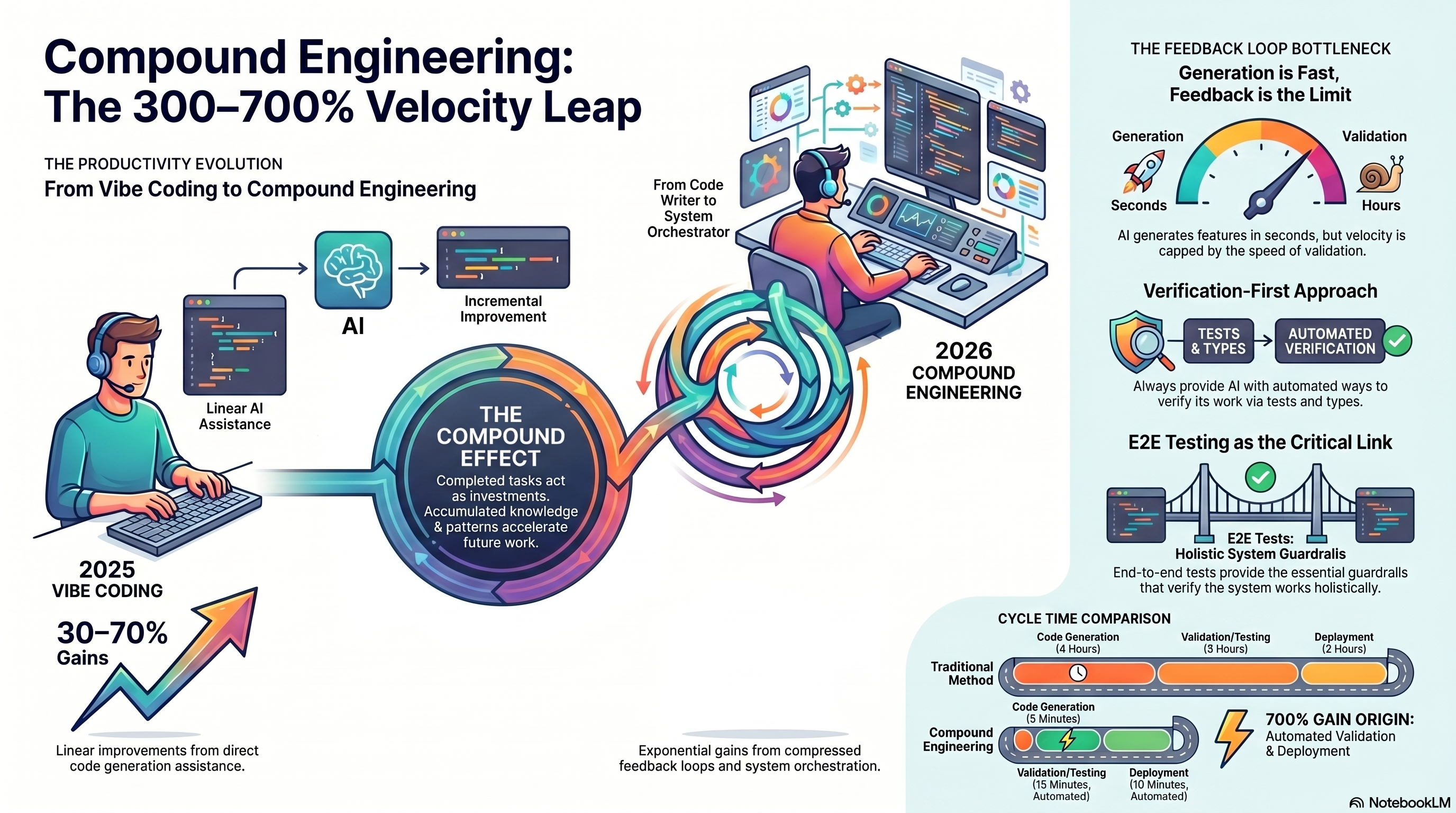
What Are Vibe Coding and Agentic Engineering?
Vibe coding is the art of building software through intuition and rapid iteration—opening your editor, letting ideas flow, and discovering the solution as you code. It’s fast, creative, and often messy. The “vibe” guides you; you refactor when it feels wrong, add features when inspiration strikes, and ship when it feels done.
Agentic engineering is the discipline of building AI systems with explicit contracts, observable state, and repeatable processes. It treats AI agents not as creative tools but as engineering components that need clear specifications, testable behavior, and predictable outcomes [Source: Compound Engineering principles, 2025].
The key difference isn’t speed—both can be fast. The difference is intentionality. Vibe coding trusts your intuition; agentic engineering trusts your systems. Vibe coding works because YOU understand the messy code. Agentic engineering works because the SYSTEM understands the clean specifications.
💡 Why this shift matters: As of 2026, AI has moved from experimental to production. Vibe coding got us here—it’s how thousands of developers learned to work with AI. But as AI agents take on critical tasks, vibe coding is hitting a wall. Teams that adopted agentic engineering practices report 3-5x higher reliability and 2-3x faster iteration when things break [Source: Anthropic production surveys, 2025].
The Vibe Coding Origins
When I first started building software, I was a vibe coder. I’d get an idea, open my editor, and just go. No diagrams, no overthinking—just code flowing like a conversation with the computer. It was fast, fun, and often messy.
That vibe coding mindset served me well for years. I could spin up a prototype in an afternoon, test it with friends, and iterate quickly. There was a certain magic to it: the feeling that the code almost wrote itself, guided by intuition and momentum.
What vibe coding looks like:
1. Get idea in the shower
2. Open editor that evening
3. Code for 3 hours, following the flow
4. Push to GitHub at midnight
5. Wake up, realize half of it doesn't work
6. Fix the broken parts over coffee
7. Ship by noon
This isn’t bad. In fact, it’s often the fastest way to explore new ideas and learn what works. The problem isn’t vibe coding itself—it’s assuming vibe coding scales to production AI systems.
The Problem with Vibe Coding for AI Agents
Vibe coding thrives on ambiguity. You lean on your mental model, keep things loosely defined, and trust that you’ll understand it later.
With traditional software, that sometimes works because the execution is deterministic. But AI agents have non-deterministic cores (LLMs) and emergent behaviors. What’s “good enough” for a script becomes a fragile contract when an agent needs to hand off work to another agent, or when you need to reproduce a failure.
My first multi-agent project was a spaghetti monster.
I had agents calling each other with handshake protocols that lived only in my head. When something broke, I’d spend hours untangling the flow. The vibe that once felt like speed now felt like technical debt snowballing.
Specific problems I hit:
-
Implicit contracts: Agents expected data in specific formats, but nothing was documented. When formats changed, everything broke silently.
-
No observability: When an agent made a bad decision, I had no way to trace WHY. The reasoning was lost in the context window.
-
Fragile dependencies: Agent A depended on Agent B’s behavior, but B’s behavior shifted slightly with prompt changes, breaking the whole system.
-
Impossible debugging: I couldn’t reproduce failures because the agent’s state was hidden inside the LLM’s context.
These problems don’t exist with traditional vibe coding because you can always read the code and understand what’s happening. With AI agents, the “code” includes the prompt, the context, the model’s internal state—and the vibe stops being reliable.
What Agentic Engineering Actually Means
Agentic engineering isn’t about giving up creativity. It’s about intentional design applied to autonomous systems.
It means:
- Explicit contracts: Define what each agent expects and returns, just like you would an API
- Observable state: Make agent thoughts, decisions, and actions visible. Log like you’re leaving breadcrumbs for your future self
- Idempotent steps: Design workflows where retrying a step doesn’t break things. AI agents fail; your system shouldn’t crumble
- Composition over cleverness: Build small, focused agents that can be combined in different ways, not monolithic brains that do everything
This mindset shift is what I call moving from vibe to engineering. You still get to be creative—but within guardrails that keep the system from collapsing when you change one piece.
The Four Pillars of Agentic Engineering
1. Explicit Contracts
Every agent interaction should have a defined interface:
# Not this:
agent_a.process(user_input)  # What does it return? No one knows!

# This:
class AgentA:
    def process(self, input: UserInput) -> AgentOutput:
        """
        Takes user input, returns structured output with:
        - action taken
        - reasoning summary
        - confidence score
        - next steps (if any)
        """
The benefit: When something breaks, you know exactly where to look. When you need to modify behavior, you know exactly what will break.
2. Observable State
Agents should write their decisions to a log:
def agent_decides(context):
    # Log BEFORE acting
    log_decision({
        "agent": "planner",
        "context_summary": summarize(context),
        "options_considered": ["A", "B", "C"],
        "chosen": "B",
        "reasoning": "B minimizes risk while meeting requirements"
    })

    # Then act
    return action_B
The benefit: When something goes wrong, you have a trail of breadcrumbs. You can trace the agent’s “thought process” and understand WHY it made the choices it did.
3. Idempotent Operations
Agents will fail and retry. Design for it:
def process_payment(payment_id):
    # Check if already processed
    if already_processed(payment_id):
        return existing_result  # Idempotent!

    # Otherwise, process
    result = payment_gateway.charge(payment_id)
    mark_processed(payment_id, result)
    return result
The benefit: When an agent retries (and it will), you don’t double-charge customers or create duplicate records.
4. Composable Design
Build small agents that do one thing well:
┌──────────┐     ┌──────────┐     ┌──────────┐
│ Planner  │────▶│ Executor │────▶│ Verifier │
└──────────┘     └──────────┘     └──────────┘

Each agent: small, focused, testable, replaceable
NOT this:
┌──────────────────────────────────────┐
│       MONOLITHIC AGENT               │
│  (plans, executes, verifies, logs,   │
│   monitors, reports, analyzes...)    │
└──────────────────────────────────────┘
The benefit: You can swap out individual agents without rewriting the whole system. You can test each component in isolation.
How I Bridge Both Mindsets
I haven’t abandoned vibe coding entirely. I still use it for exploration: trying a new prompt pattern, testing a library, or building a one-off script.
The difference now: I treat the prototype as an experiment, not as the final product.
Once something works, I refactor it into a proper agent component with:
- Clear interfaces (explicit contracts)
- Logging at key decisions (observability)
- Error handling and retries (idempotency)
- Tests for expected behavior (verification)
A Practical Trick: The Spec Document
I start every new agent with a spec document (even a short one). It answers:
- What is this agent’s job in one sentence?
- What inputs does it need? What format?
- What does success look like?
- What does failure look like?
- How will we know if it’s working?
That simple discipline catches so many problems before I write a single line of code. It forces me to think through the interfaces, edge cases, and success criteria—while still leaving room for creative exploration during implementation.
🎯 Real talk: This spec document takes 10 minutes to write. It saves hours of debugging later. It’s the highest-leverage practice I’ve adopted.
Tools That Help
I’ve been using Antfarm patterns to orchestrate specialized agents. The key insight: each agent has a single responsibility and communicates via structured messages.
It’s like moving from monolithic scripts to microservices, but for AI. The vibe is still there—I get to design how agents think and interact—but the engineering ensures that when one agent goes off the rails, the others stay grounded.
What Antfarm provides:
- Structured agent definitions (AGENTS.md)
- Clear handoff protocols
- Logging and observability built-in
- Retry and error handling
- Testable workflows
What I still do with vibe coding:
- Initial exploration of ideas
- Testing prompt patterns
- Rapid prototyping of agent behaviors
- Creative problem-solving when stuck
The combo is powerful: vibe for exploration, engineering for production.
When to Use Each Approach
Vibe Coding Is Best For:
✅ Learning a new technology or library ✅ Exploratory projects and prototypes ✅ One-off scripts and tools ✅ Creative coding and experimentation ✅ Projects where you’re the only user
Rule of thumb: If the cost of failure is low (your time only), vibe code away.
Agentic Engineering Is Best For:
✅ Production AI systems with real users ✅ Multi-agent workflows with handoffs ✅ Systems where reliability matters ✅ Teams working on shared codebases ✅ Anything that will run without you present
Rule of thumb: If others depend on it, engineer it properly.
The Transition Path
You don’t have to flip a switch. Here’s how I transitioned:
Phase 1: Add Specs to Existing Projects
- Write one-page specs for your agents
- Document inputs/outputs
- Define success criteria
Phase 2: Add Observability
- Log key decisions
- Track agent states
- Make failures visible
Phase 3: Add Testing
- Write tests for critical paths
- Test agent responses to edge cases
- Validate outputs match specs
Phase 4: Refactor for Composition
- Break large agents into smaller ones
- Define clear interfaces between agents
- Make components swappable
Each phase builds on the previous one. You can stop at any point—Phase 1 alone will dramatically improve your agent reliability.
Frequently Asked Questions
Q: Is vibe coding dead? Should I stop doing it?
Absolutely not! Vibe coding is still the fastest way to explore ideas and learn. Just treat it as exploration, not as production. When something works and you want to deploy it, take the time to engineer it properly.
Q: Do I need to use Antfarm or similar tools?
No. The principles matter more than the tools. You can engineer agents properly with vanilla Python and good practices. Tools like Antfarm just make it easier by providing patterns and scaffolding.
Q: This sounds like more work. Is it worth it?
For prototypes and personal projects? Maybe not. For production systems with real users? Absolutely. The time you invest upfront pays back 10x in reduced debugging, faster iteration, and fewer production incidents.
Q: Can I be too rigid? Is there such thing as over-engineering agents?
Yes, absolutely. I’ve seen teams build elaborate frameworks for simple one-agent tasks. The goal is intentional design, not bureaucracy. Engineer what needs to be reliable; vibe-code the rest.
Q: How do I know when I’ve gone too far in either direction?
Signs you’re over-vibe-coding: same bugs keep happening, you can’t reproduce failures, handoffs break mysteriously.
Signs you’re over-engineering: you spend more time documenting than coding, you can’t ship features quickly, everything feels bureaucratic.
The sweet spot is in the middle—enough structure for reliability, enough freedom for creativity.
Further Reading
- Compound Engineering: The Next Paradigm Shift — The broader context of engineering with AI
- Antfarm Patterns for Agent Teams — Production agent orchestration
- Context Engineering Beyond Prompt Engineering — Managing agent context properly
- The Reliability Chasm in AI Agents — Why agent reliability is so hard
About the Author
Vinci Rufus went from vibe coding everything to embracing agentic engineering the hard way—by watching his early agent systems collapse under their own complexity. He still vibes on new ideas but engineers everything that ships. He believes the best developers know when to use each approach. Find him on Twitter @areai51 or at vincirufus.com.
Last updated: February 27, 2026