TL;DR
- The industrial age of software is here: Agent factories will write the majority of production code
- The SDLC is being rewritten: Product owners ship directly to agents; engineers become reviewers and orchestrators
- The 60-90% shift: Most implementation code will be generated by cloud-based agent factories, not laptops
- Humans move upstack: From writing code to reviewing, architecting, and quality engineering
The Craft Era Is Ending
For seventy years, software engineering has been a craft. A skilled artisan sat at a machine, understood the problem deeply, and translated intent into instructions. The tools evolved—punch cards gave way to terminals, terminals to graphical IDEs, IDEs to cloud-based environments—but the fundamental model remained: a human, writing code.
Even the first wave of AI coding assistants preserved this model. GitHub Copilot, Cursor, Claude Code—these are power tools for the craftsperson. They make the artisan faster, sharper, more productive. But the artisan is still at the center. The code still originates from a human mind, refined through a CLI on a local laptop.
That model is about to collapse.
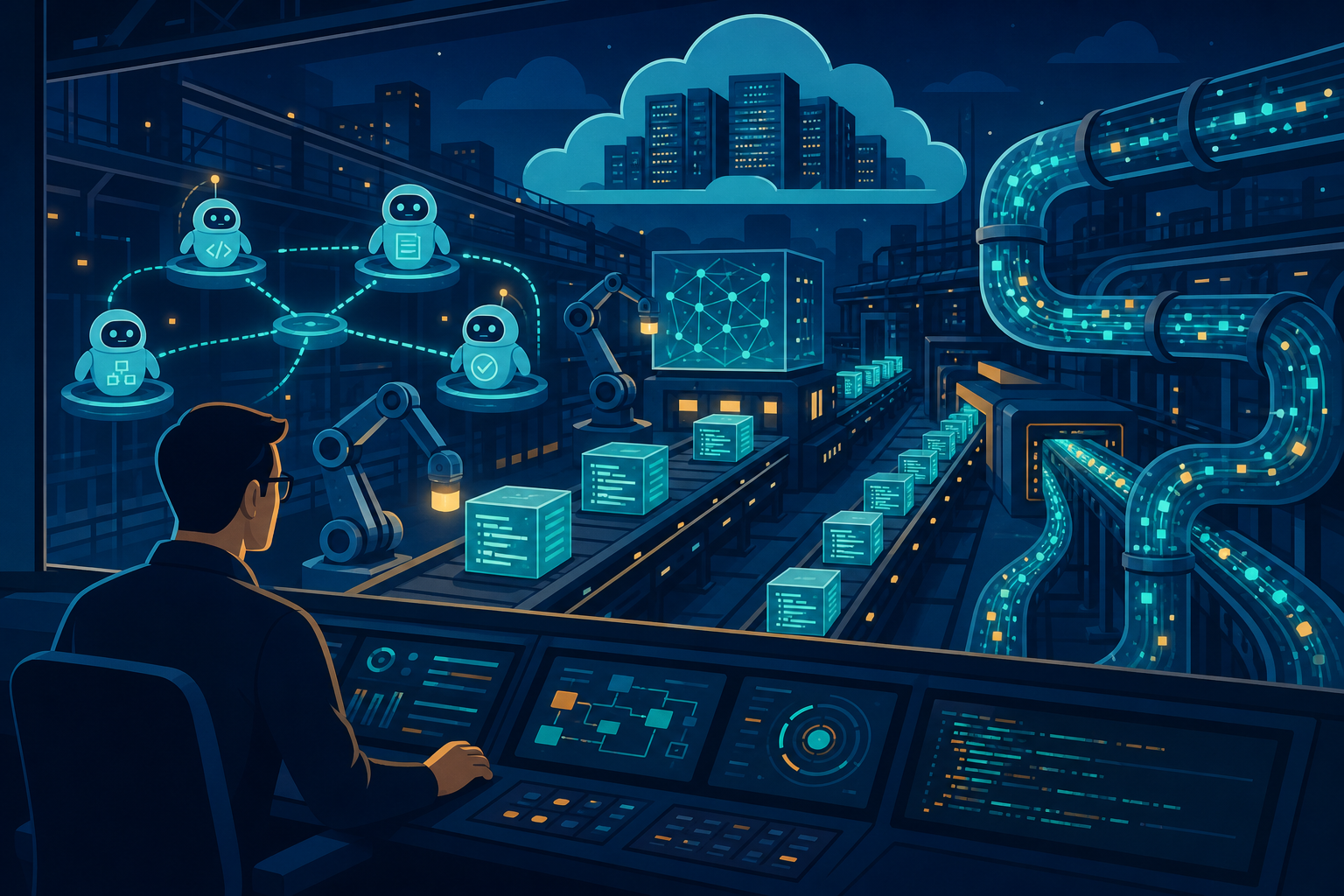
We are not merely entering an era of better tools. We are entering the industrial age of software engineering—where code is manufactured at scale in cloud-based agent factories, and human engineers shift from craftsmen to factory operators, quality engineers, and systems architects.
The Assembly Line Arrives
Consider how physical manufacturing evolved. For millennia, goods were crafted by individual artisans. Then came the factory, the assembly line, and mass production. The artisan did not disappear—but their role transformed. Fewer people hand-forged tools; more people designed assembly lines, operated machines, and inspected output.
Software is on the same trajectory.
Today, the typical SDLC looks like this:
Product Owner creates user stories
         ↓
Stories enter a backlog, waiting for an engineer
         ↓
Engineer picks up task, writes code on their laptop
         ↓
QE verifies the implementation
         ↓
Ship to production
This is the craft model. The bottleneck is always the engineer’s capacity to write code. Backlogs grow. Sprint velocity becomes a obsession. We hire more artisans to keep up with demand.
Tomorrow’s SDLC will look radically different:
Product Owner creates a user story
         ↓
Story is sent directly to the Agent Factory
         ↓
Factory writes 60-90% of the code
         ↓
Human engineer reviews the PR, architects edge cases, QE validates
         ↓
Ship to production
The shift is not incremental. It is structural. The locus of code generation moves from the engineer’s laptop to a cloud-based agent factory. The locus of human value moves from implementation to review, architecture, and orchestration.
What Is an Agent Factory?
An agent factory is not a single AI model. It is not a chat interface. It is an industrial system for software production—a cloud-native environment where hundreds or thousands of specialized agents collaborate to turn product requirements into production-ready code.
Think of it as the software equivalent of a modern manufacturing plant:
| Manufacturing | Software (Agent Factory) |
|---|---|
| Raw materials | Product requirements, user stories, API contracts |
| Assembly line | Orchestrated agent workflows (plan → build → test → review) |
| Robotic arms | Builder agents generating implementation code |
| Quality control | Reviewer agents, security scanners, human QE |
| Factory floor | Cloud-native compute, ephemeral environments, parallel execution |
| Plant manager | Human engineer orchestrating, debugging, refining |
The factory operates at a scale no individual engineer can match. Agents work in parallel. Tests run continuously. Reviews happen automatically. The system learns from every PR, every bug, every regression—compounding knowledge over time.
And unlike human engineers, the factory never sleeps, never context-switches, and never forgets what it learned last quarter.
The 60-90% Reality
The “60-90%” figure is not optimistic speculation. It is already observable in early adopters.
Consider what modern agentic systems can already do:
- Plan: Research a codebase, understand conventions, and produce detailed implementation specifications
- Build: Generate thousands of lines of typed, tested code from a spec in minutes
- Test: Write and execute unit, integration, and edge-case tests in parallel
- Review: Apply multi-agent review for security, performance, pattern compliance, and correctness
- Iterate: Automatically refine based on test failures and review feedback
The gap between human-written and agent-generated code is narrowing rapidly. In routine CRUD operations, standard API endpoints, boilerplate frontend components, and migration scripts, agents already match or exceed median human quality. The remaining 10-40%—complex architectural decisions, novel algorithmic work, deep domain logic, and creative problem-solving—remains firmly human.
But that is precisely the point. The factory handles the routine so humans can focus on the exceptional.
What Happens to Engineers?
The fear is always the same: “If agents write the code, what do I do?”
The answer, drawn from every industrial revolution in history, is: you move upstack.
From Writer to Reviewer
When the factory generates 80% of the code, the human engineer’s primary job becomes review and validation. Not a shallow skim, but deep architectural review: Does this match our conventions? Are there edge cases the agents missed? Does this integrate cleanly with the existing system?
Review becomes the bottleneck, and therefore the high-value activity. The engineer who can spot a subtle race condition in agent-generated code is more valuable than the engineer who can write a standard API endpoint.
From Implementer to Orchestrator
Someone must run the factory. Agent factories require human operators to:
- Define the workflows and agent specializations
- Set the quality gates and review criteria
- Debug when agents fail or produce suboptimal output
- Tune the system based on production feedback
This is a new engineering discipline: agent factory operations. It combines software architecture, systems thinking, and quality engineering in ways traditional CS curricula do not teach.
From Coder to Architect
With implementation largely automated, the scarce resource becomes design intent. The engineer who can decompose a business problem into clean abstractions, define explicit contracts between systems, and architect for reliability at scale becomes the pivotal role.
Code is cheap. Intent is expensive.
The New SDLC
The agent factory does not merely accelerate the existing SDLC. It restructures it.
Current State: The Human Bottleneck
┌─────────────┐     ┌─────────────┐     ┌─────────────┐     ┌─────────────┐
│   Product   │     │   Backlog   │     │   Engineer  │     │     QE      │
│   Owner     │ →   │   Queue     │ →   │   Codes     │ →   │   Verifies  │
└─────────────┘     └─────────────┘     └─────────────┘     └─────────────┘
      ↑                                                       ↓
      └───────────────────────────────────────────────────────┘
                              Ship
The backlog is a queue. The engineer is the bottleneck. Velocity is constrained by human typing speed, cognitive load, and calendar availability.
Future State: The Factory Pipeline
┌─────────────┐     ┌─────────────────────────────────────┐     ┌─────────────┐
│   Product   │     │          Agent Factory              │     │   Human     │
│   Owner     │ →   │  Plan → Build → Test → Auto-Review │ →   │   Review    │
└─────────────┘     └─────────────────────────────────────┘     └─────────────┘
                                          ↑                        ↓
                                          └────────────────────────┘
                                                    Ship
The backlog becomes a pipeline. The factory is the engine. The human engineer operates at the edges—defining input, validating output, handling exceptions.
Notice what disappeared: the queue. Stories do not wait for an engineer to have bandwidth. They enter the factory and progress continuously. The human review step becomes a quality gate, not a capacity constraint.
Implications for Engineering Leaders
If you lead an engineering organization, the agent factory is not a distant future. It is a strategic imperative you must prepare for now.
1. Restructure Teams for Review, Not Output
Measure what matters. When agents generate code, “lines written” and “story points completed” become meaningless. The metrics that matter shift to:
- Review depth: Are we catching edge cases agents miss?
- Architecture quality: Is the system getting simpler or more complex over time?
- Factory throughput: How many stories can we process end-to-end per day?
- Error rate in production: Are agent-generated changes more or less buggy than human-written ones?
2. Invest in Factory Infrastructure
The companies that win will be the ones that build or adopt the best agent factories. This means:
- Standardized specifications: Agent factories need structured input. Invest in tools that let product owners express intent in machine-readable ways.
- Observability: Every agent decision must be logged, reviewable, and debuggable. Black-box factories will not pass audit or security review.
- Quality gates: Automated security scanning, performance regression detection, and pattern compliance must be built into the factory pipeline.
- Learning loops: The factory must compound knowledge. Every bug in production should refine the agents that come after.
3. Retrain for Orchestration
Your best engineers may resist this shift. They became great by writing great code. Now you are asking them to review code written by machines.
This is a cultural and psychological transition. Some will adapt and thrive as architects and operators. Others will not. Start the conversation early. Define the new career ladders: Agent Factory Engineer, Quality Architect, Systems Orchestrator.
4. Rethink Vendor Relationships
The agent factory is a platform decision. Whether you build in-house (using frameworks like Antfarm, compound engineering workflows, or custom agent orchestration) or adopt a vendor solution, this choice will shape your engineering velocity for the next decade.
Evaluate vendors not on model benchmarks, but on:
- Integration depth: Can the factory read and reason about your specific codebase?
- Observability: Can you see why an agent made a decision?
- Composability: Can you swap in specialized agents for your domain?
- Safety: What guarantees exist around security, data privacy, and compliance?
The Human Role Remains Central
It is worth stating clearly: this is not the end of human software engineering. It is the end of human software engineering as a manual craft.
The industrial revolution did not eliminate human ingenuity from manufacturing. It eliminated the need for humans to perform repetitive mechanical tasks by hand, and in doing so, it unleashed human ingenuity at scale. The same will happen here.
The engineer who once spent hours writing CRUD endpoints will now spend those hours:
- Designing the system that ensures the factory produces reliable output
- Debugging why an agent misunderstood a domain constraint
- Architecting the quality gates that prevent regressions
- Researching the novel algorithm that the factory cannot yet generate
The work becomes more interesting, more strategic, and more valuable. But it is different work, and the transition will be uncomfortable.
Preparing for the Shift
If you are an engineering leader, start now:
- Audit your SDLC: Where is the human bottleneck today? Where could a factory take over?
- Experiment with agentic workflows: Do not wait for a perfect platform. Use compound engineering, multi-agent review, and automated planning today.
- Measure factory readiness: Track how much of your codebase is routine vs. novel. The higher the routine percentage, the faster a factory will deliver value.
- Invest in review culture: If review becomes the primary human activity, make your team exceptional at it.
- Plan for the role transition: Have honest conversations with your team about what engineering looks like in three years.
Conclusion
The software industry has long prided itself on being immune to industrialization. Every line of code was bespoke, every system a unique creation. That era is closing.
The agent factory is not a tool. It is a system of production—one that will write the majority of the world’s routine software, operate continuously in the cloud, and compound its knowledge with every deployment.
The question for engineering leaders is not whether this will happen. It is whether you will be operating the factory, or watching from the outside as your competitors scale past you.
The industrial age of software is here. The assembly line is being built. The only question is: who runs it?